Technology | 7 Minutes Reading
How to Present Email Evidence in Court
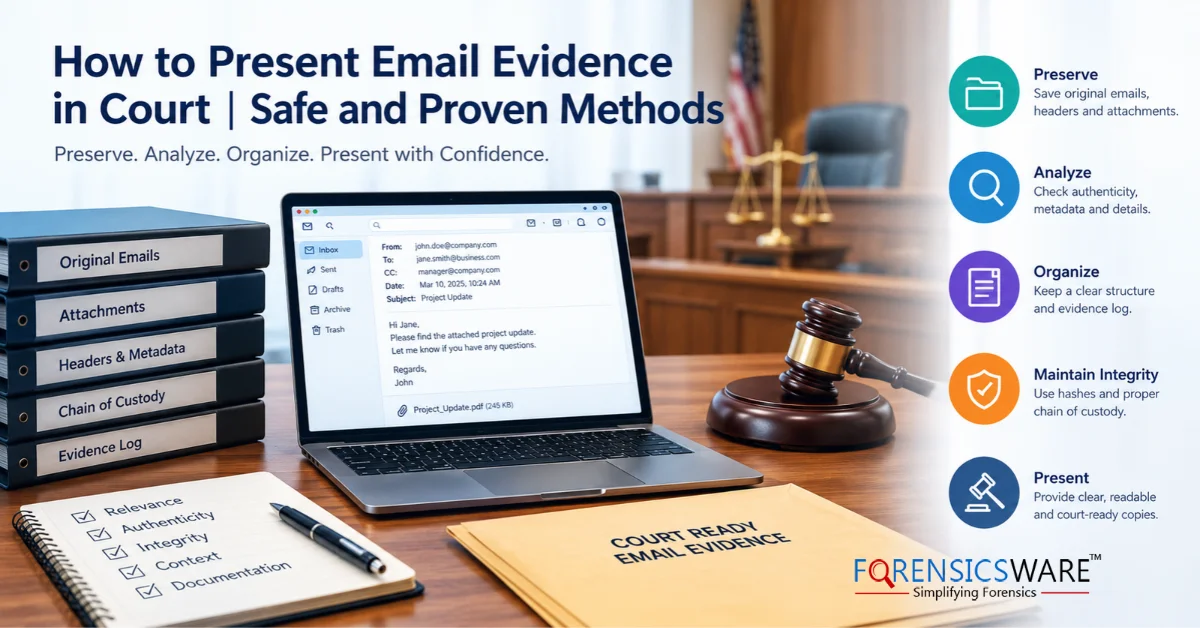


Did you know that email messages can help to clarify what was discussed, promised, agreed upon or disputed during a legal matter? However you also need to be aware that only saving email as a PDF or simply printing their screenshot does not automatically make it a reliable source of evidence. Anyone who is researching or wanting to know how to present email evidence in court then they need to consider the original message, its headers, attachments, authenticity and lastly the way it was collected and preserved.
A strong collection of email evidence must be structured in the proper way so that a lawyer, investigator or any other reviewer can easily understand its messages, verify their source, trace their history and also determine how they relate to the matter in dispute. The objective here is not simply to present emails that look credible but to preserve sufficient information so that others can easily examine them and challenge it fairly.
This simple guide will explain to you how to properly prepare email evidence using step by step methods. You will learn how to avoid common mistakes when preserving evidence and also how to organize your electronic records for legal review.
Table of Content
- What Makes Email Suitable for Court Evidence?
- Step 1: Preserve the Original Email Before Preparing a Copy
- Step 2: Include Complete Email Details
- Step 3: Examine Full Email Headers
- Step 4: Check Email Attachments
- Step 5: Analyze Large Mailboxes Without Losing Relevant Context
- Court Ready Email Evidence Checklist
- Final Thoughts
What Makes Email Suitable for Court Evidence?
Email is very useful in legal proceedings when its relevance, authenticity, context and their integrity can be clarified. Any specific requirements depend on the jurisdiction, the type of case and the applicable rules of evidence. So before we start deciding how to present email evidence in court you must consider these five questions:
- Relevance: What fact or issue does email help to establish?
- Authenticity: What supports the claim that the message is authentic?
- Integrity: Has the original message been preserved and can any changes be identified?
- Context: Does the evidence include enough conversation to avoid misleading impressions?
- Documentation: Can someone explain when, where and how the email was collected?
Let’s look at a practical example: imagine a supplier sends an email to a customer confirming that a shipment will arrive by a specific date. Later this did not happen so now the customer claims that no delivery date was ever agreed upon. In this case a useful set of evidence simply includes the confirmation email along with its date and recipient details also any related replies, attachments and information on how the electronic record was securely maintained.
Step 1: Preserve the Original Email Before Preparing a Copy
Before you prepare email evidence for court submission here you need to secure the original message in its native format like EML, MSG or MBOX whenever possible. You should also avoid relying on screenshots, forwarded emails or PDFs as these may not retain all original headers and metadata. Check below some important tips.
- Must keep original email in source mailbox when possible.
- Export message using the right collection method.
- Store untouched copy separately from working files.
- Record collection date, time, source and method.
- Avoid modifying or resaving the original file.
Important: A email file in its original format does not simply prove its authenticity however it is also necessary for users to evaluate its origin, integrity and how it has been handled. If there is a risk that the email might be deleted or lost then you should seek legal assistance.
Step 2: Include Complete Email Details
If I talk about court ready email copy well it should include relevant message details and conversation context. You should also avoid presenting the selected lines that could change the original meaning. Check below table to know what and how to present email evidence in court.
| Email element | Why it matters |
|---|---|
| From | Help to identify sender address. |
| To | Shows primary recipients. |
| CC | Allow to show copied recipients. |
| BCC | Shows hidden recipients. |
| Date and time | Shows date of email with time |
| Subject | Identifies conversation. |
| Email body | Keep relevant message content. |
| Attachments | Identifies related files. |
| Message identifiers and headers | Help to examine the identity of the message. |
Step 3: Examine Full Email Headers
It is important to examine full email header as it contains technical details that help to explain the origin of a message and how it reached to the recipient. There are some Important fields like Message-ID, Received, Return-Path, Reply-To, Date Etc., (SPF, DKIM and DMARC).
Now during the email header analysis for legal investigations you can check these details for any unusual timestamps, sender differences or if there is any missing information.
Step 4: Check Email Attachments
Attachments such as invoices and contracts can be important when you present email evidence in court. Therefore you must keep the original files, link them to the email from which they originated and simply check for any missing files or the presence of different versions. Remember that a file name alone does not prove that an attachment is authentic.
Step 5: Analyze Large Mailboxes Without Losing Relevant Context
Your large mailboxes may contain thousands of emails which makes manual review more difficult. In this case you can use advanced search to locate all the relevant messages based on date, sender, recipient, subject, keywords and attachments. You can examine entire conversations and check for any duplicate messages to ensure no important details are overlooked.
Let’s take an example: If you are searching only for “payment overdue” well this may miss emails that are containing “outstanding balance” or an invoice number. You can use related keywords and record the search filters that will make the review easier to verify.
If you have MBOX and MSG files then you can download the MBOX Viewer Pro tool which helps you to Open MBOX File and find specific email by date, time and also allows you to print as PDF.
For MSG files you can Download MSG Viewer Pro tool to Open MSG File and comes with the same advanced features it also offers conditional based search filters like AND, OR, NOT which help you to easily locate the information you want and print them for court ready documents. This is best if you are dealing with large MSG file data.
Remember: Search results to Present Email Evidence in Court help you to locate evidence but it does not prove authenticity or guarantee legal admissibility. So you should keep original emails and document the collection.
Court Ready Email Evidence Checklist
Before Present Email Evidence in Court or handing over your evidence package to a lawyer, investigator or any authorized reviewer you must once review this checklist and ensure that the following items are verified.
- Original email or relevant data source.
- Collection date, time, source and method are documented.
- Sender, recipients, date, subject and relevant body text are readable.
- The full relevant conversation has been examined.
- Headers and technical metadata have been preserved.
- Relevant attachments have been collected and linked to source messages.
- Hashes have been calculated and documented.
- The chain of custody and storage arrangements are recorded.
- Readable copies are clearly distinguished from the stored source files.
- Applicable legal and procedural requirements have been checked.
Completing this checklist for Present Email Evidence in Court will help you to quickly organize the material but it also does not guarantee that court will admit the evidence.
Final Thoughts
Knowing how to present email evidence in court simply means more than just printing emails. You must secure original emails, headers and attachments. You should also keep a clear chain of custody and record how the evidence was collected and it was handled. The more important thing is to organize your emails so lawyers and reviewers can easily understand the meaning of the message and can check their source. Keep your original files safe so use readable copies for presentation and note any missing details. Finally you need to check the legal requirements before Present Email Evidence in Court or submitting the evidence. These simple steps will help you to make email evidence clear, organized and easier to verify.